
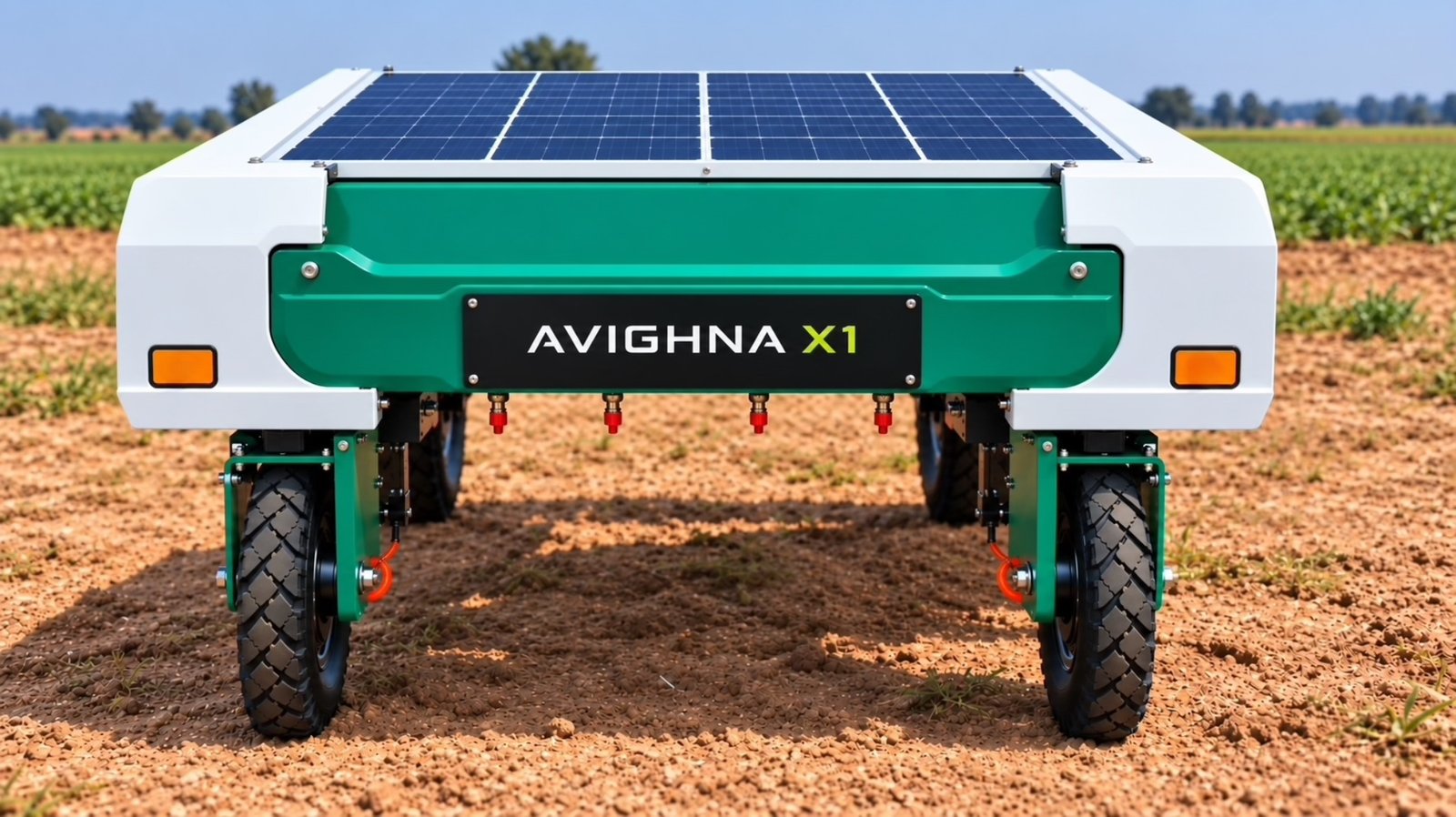
Discover how AI-powered autonomous farm robots are transforming Indian agriculture. Explore GNSS RTK navigation, LiDAR, precision seeding, targeted spraying and the development of Pragyanik AI’s Avighna X1 multifunctional farm robot.
Autonomous Farm Robots in India: How AI Is Transforming Modern Agriculture
Agriculture is evolving with the introduction of Artificial Intelligence (AI), robotics and precision farming technologies. Autonomous farm robots are emerging as an innovative solution to help automate agricultural operations, improve precision and reduce repetitive manual work.
In India, where farming conditions vary across regions, crops and field sizes, agricultural robotics can play an important role in the future of smart farming.
Pragyanik AI Private Limited, an AgriTech and robotics company based in Indore, Madhya Pradesh, is developing AI-powered agricultural robots and precision farming solutions for Indian agricultural conditions.
What Is an Autonomous Farm Robot?
An autonomous farm robot is a robotic platform designed to perform agricultural operations using navigation systems, sensors, cameras, software and mechanical attachments.
Depending on its configuration, an agricultural robot can support:
* Precision seeding
* Targeted crop spraying
* Mechanical weed removal
* Crop monitoring
* Fertilizer application
* Agricultural material handling
These systems aim to make farming operations more precise and consistent.
Technologies Used in Agricultural Robotics
Modern agricultural robots combine multiple technologies to perform field operations.
1. GNSS RTK Navigation
GNSS RTK technology provides precise positioning information. It can help agricultural robots follow planned paths and perform repeatable field operations.
2. LiDAR Technology
LiDAR sensors measure distances and help robotic systems understand their surroundings. They can support navigation and obstacle detection.
3. AI Vision and Machine Vision
AI vision systems process camera images to identify objects and distinguish between different elements in the field, depending on the camera configuration and trained models.
4. Modular Robotic Attachments
Modular attachments allow a robotic platform to support multiple agricultural operations without requiring a separate machine for every task.
Avighna X1 – Pragyanik AI’s Autonomous Farm Robot
Pragyanik AI is developing Avighna X1, a multifunctional agricultural robot designed to support multiple farming operations through modular robotic attachments.
The development focuses on precision, navigation and the integration of different agricultural modules on a single robotic platform.
Agricultural Modules Tested on Avighna X1
The current prototype development and testing programme includes:
1. Precision Seeding
A module developed for controlled seed placement during agricultural operations.
2. Targeted Spraying
A spraying module designed to support application-specific crop spraying.
3. UV-C-Based Pest Control
A UV-C-based pest-control module being tested as part of the prototype’s agricultural applications.
4. Mechanical Weeding Using a Delta Arm
A delta-arm-based mechanical weeding module developed for targeted weed removal.
Avighna X1 Prototype Testing
The prototype has undergone navigation testing and testing of its agricultural modules.
Reported prototype testing parameters:
* Payload tested: 150 kg
* Runtime tested: 5–6 hours
* Navigation technologies: GNSS RTK and LiDAR
* Modules tested: Precision seeding, targeted spraying, UV-C pest control and delta-arm mechanical weeding
These figures represent the tested prototype configuration. Future configurations may have different specifications and capabilities.
Benefits and Applications of Agricultural Robots
Autonomous agricultural robots have the potential to support different farming activities.
Some potential applications include:
* Precision farming operations
* Targeted crop spraying
* Mechanical weed removal
* Precision seeding
* Crop monitoring
* Agricultural research and field demonstrations
Their practical performance depends on crop conditions, terrain, robot configuration and the specific agricultural attachment being used.
Why Agricultural Robotics Matters for Indian Farmers
Indian agriculture includes diverse crops, farm sizes and field conditions. Agricultural robotics can help address challenges related to labour availability, operational precision and repetitive field activities.
Locally developed robotic platforms can be designed and adapted to meet the specific requirements of Indian farming conditions.
The Future of AI Agriculture Robots in India
The future of agricultural automation will increasingly involve robotics, artificial intelligence, machine vision, GNSS positioning and intelligent mechanical systems.
Indian AgriTech companies have an opportunity to develop affordable and practical technologies for farmers, agricultural businesses and research organisations.
Pragyanik AI is working towards this vision through the development of Avighna X1, Avighna X1 Lite and other precision farming technologies.
About Pragyanik AI Private Limited
Pragyanik AI Private Limited is an Indian AgriTech and robotics company headquartered in Indore, Madhya Pradesh.
The company’s technology portfolio includes:
* Avighna X1 – Multifunctional autonomous farm robot
* Avighna X1 Lite – Compact agricultural robotics platform
* Eravat M1 – Material handling robot
* Drona – GNSS-based precision land levelling system
* Other precision farming and agricultural automation solutions
Website: https://www.pragyanikai.com/
Explore our solutions: https://www.pragyanikai.com/solutions.php
Frequently Asked Questions
What is an autonomous farm robot?
An autonomous farm robot is a robotic platform designed to perform agricultural activities using navigation systems, sensors, software and specialised attachments.
What is Avighna X1?
Avighna X1 is a multifunctional agricultural robot under development by Pragyanik AI for precision farming operations.
Which technologies are used in Avighna X1?
Its prototype uses GNSS RTK and LiDAR-based navigation technologies.
Which agricultural modules have been tested on Avighna X1?
Precision seeding, targeted spraying, UV-C-based pest control and delta-arm mechanical weeding modules have been tested on the prototype.
What is the tested payload of Avighna X1?
The reported prototype payload testing figure is 150 kg.
What is the runtime of the Avighna X1 prototype?
The reported prototype runtime is 5–6 hours.
Published by: Pragyanik AI Team
Location: Indore, Madhya Pradesh, India