
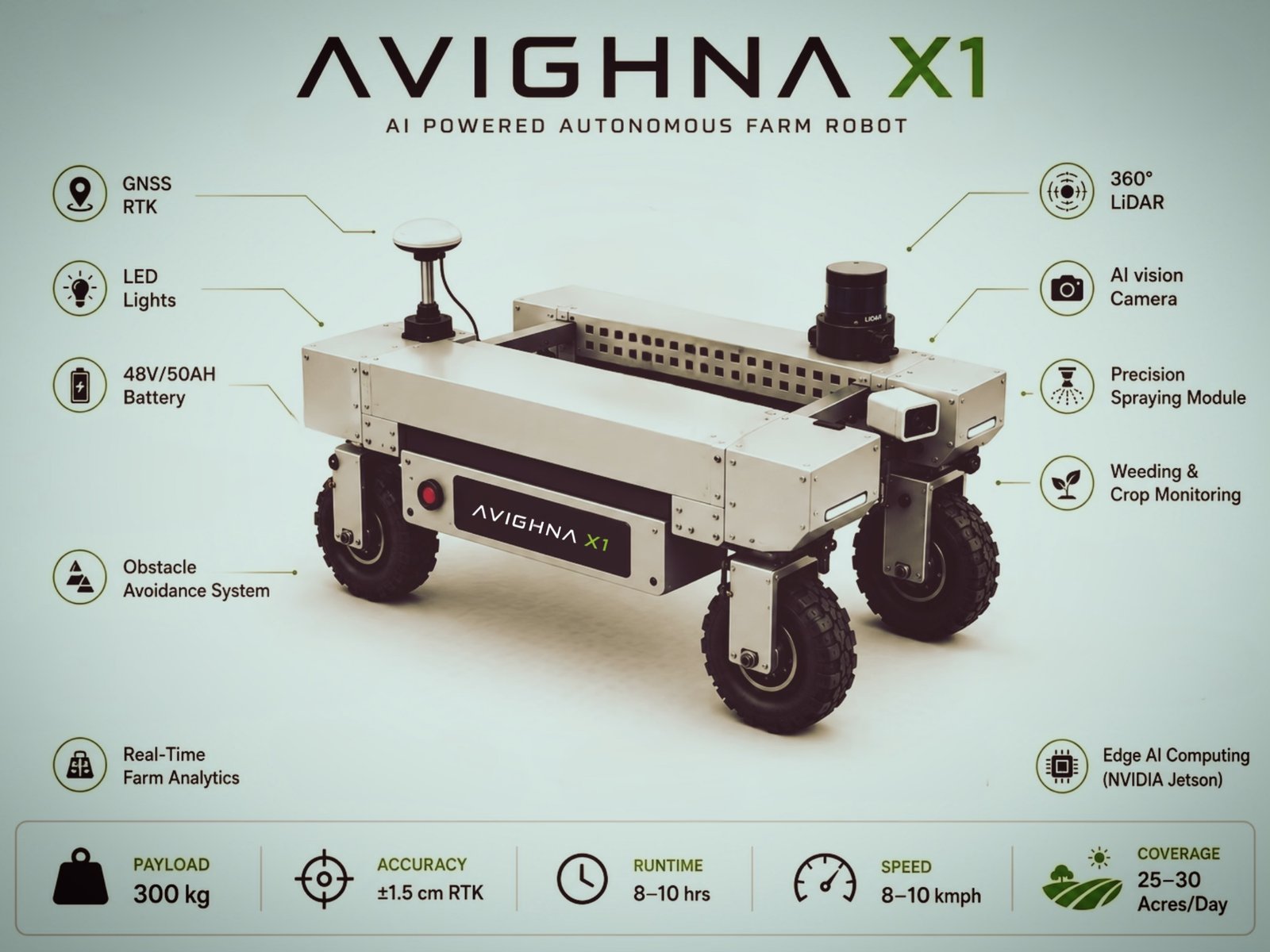
India's first modular AI farm robot, Avighna X1 combines GNSS RTK navigation, AI vision, and edge computing into a single autonomous platform that handles weeding, spraying, seeding, and crop monitoring. With ±1.5 cm accuracy, 25-30 acres of daily coverage, and interchangeable modules that cut labor dependency by up to 70% and chemical usage by up to 80%, Avighna X1 is built by Pragyanik AI to bring scalable, affordable automation to Indian farms.
Indian agriculture is caught in a squeeze that gets tighter every season. Farm labor is harder to find and costlier to hire than it was even five years ago, yet the list of jobs a farm needs done — weeding, spraying, seeding, crop monitoring — hasn't gotten any shorter. For most farmers, automating even one of these tasks means buying a dedicated machine, and few can justify five separate purchases for five separate jobs.
Pragyanik AI built Avighna X1 to solve exactly this problem. It's India's first genuinely modular, multi-functional AI farm robot — a single autonomous platform that can be configured to handle five or six distinct farm operations, one module at a time.
What Exactly Is Avighna X1?
Avighna X1 is an autonomous agricultural robot that combines AI, GNSS positioning, computer vision, and IoT connectivity into one platform. It isn't built around a single task. Instead, it's designed as a base unit that accepts interchangeable modules, so a farmer can start with one function — say, mechanical weeding — and add spraying, seeding, or monitoring capability later without replacing the machine itself.
This is a meaningfully different approach from most agricultural robots on the market today, which tend to be purpose-built for one job and priced accordingly. Avighna X1 instead offers a path: buy the platform once, then expand its capability as your operation grows or your budget allows.
The robot is built to work across row crops, vegetable farms, greenhouses, and open fields, and its multi-crop compatibility makes it a practical fit for Indian farms, where it's common for a single holding to grow several different crops across different plots.
Why the Modular Approach Matters
The core strength of Avighna X1 isn't any one module — it's the architecture underneath all of them. Once the base platform is set up on a farm, modules can be swapped the way you'd change a lens on a camera. Here's what each one does.
Mechanical Weeding Module
This module removes weeds without chemicals, using a blade or drag-based mechanism that adjusts to different row spacings. For crops where manual weeding is the single biggest labor cost, this module alone cuts that dependency by 50 to 70 percent — a meaningful number given how much of India's farm labor budget typically goes into weeding cycles.
Precision Seeding Module
The seeding module places seeds with controlled spacing and depth, both of which are adjustable. This reduces seed wastage and produces more uniform germination, which matters most for vegetable growers and row-crop farmers where uneven spacing directly affects yield.
Targeted Spraying Module
This is arguably the most technically demanding module on the platform. An AI vision system distinguishes between weeds and crop, then sprays pesticide or fertilizer only where it's needed — not across the entire field. The result is a 70 to 80 percent reduction in chemical usage compared to blanket spraying. That's not just a cost saving; it's a meaningful reduction in chemical exposure for the operator and less chemical load on the soil over time.
Crop Monitoring Module
This module keeps a continuous eye on the field — flagging irrigation problems, tracking plant growth, and picking up early indicators of crop stress or disease. Real-time analytics are pushed to a mobile app, so a farmer can catch a developing problem before it spreads across the field.
Harvesting Module (Custom Development)
For more complex tasks, delta-arm or cobot integration is possible, particularly for vegetable harvesting. This module is built around the specific crop in question rather than offered as a one-size-fits-all attachment.
Transport Module
Inside the field, the transport module can move tools, seed, or harvested produce from one point to another. It supports a "follow-me" mode, where the robot trails the operator, or fully autonomous point-to-point movement with a small trailer attachment.
The Technology Behind Avighna X1
Avighna X1 isn't a mechanical platform with some sensors bolted on — it's built around several technologies working together in real time.
GNSS RTK navigation gives the robot positioning accuracy of ±1.5 cm, which keeps every row and every pass precise. A 360-degree LiDAR system gives it continuous awareness of its surroundings, feeding an obstacle avoidance system that reroutes the robot around anything in its path. An AI vision camera handles the ongoing work of telling crop apart from weed, and the processing behind all of this runs on an NVIDIA Jetson edge AI computer — meaning decisions are made on the robot itself, in the field, rather than depending on a round trip to the cloud.
Operators can run the robot fully autonomously or switch to manual control through a mobile app, with remote monitoring built in either way. Connectivity covers 4G, 5G, and Wi-Fi, and a remote fleet management feature lets operators running more than one Avighna X1 manage all of them from a single dashboard.
Technical Specifications at a Glance
Avighna X1 carries a payload capacity of up to 300 kg, enough for heavier attachments and field tools. Navigation accuracy sits at ±1.5 cm RTK. A full charge gives 8 to 10 hours of continuous operation, and recharging takes just 4 to 5 hours — with a solar hybrid option available for farms in locations where reliable charging infrastructure isn't a given.
The robot moves at 8 to 10 km/h and can cover 25 to 30 acres in a single day, a figure that matters for larger farms and commercial operations weighing this against manual labor costs. It runs on a 48V/50AH battery system and carries an IP65 weather-resistant rating, so it keeps working through sun, dust, and light rain without interruption.
When the battery runs low, an auto-return-to-charging-station feature brings the robot back on its own — no need for an operator to manually retrieve it from the middle of a field.
Why Choose Avighna X1
The most immediate benefit is a 50 to 70 percent reduction in labor dependency. Farm labor availability in India keeps shrinking year over year, particularly during peak season when weeding and spraying need to happen simultaneously across multiple plots. Avighna X1 directly addresses that bottleneck.
The second major benefit is a 70 to 80 percent cut in chemical usage, driven by the targeted spraying module. That has a direct effect on input costs, and over time, a meaningful effect on soil health as well.
Third is operational efficiency: because one platform handles multiple jobs, there's no need to invest separately in five different machines. It's a multi-functional platform built on a modular, retrofit-friendly architecture — the module you buy today doesn't lock you out of adding capability tomorrow. You're not replacing the robot as your needs grow; you're adding to it.
That makes Avighna X1 less of a single-purpose machine purchase and more of a scalable investment in precision farming — one that grows alongside the operation it's serving.
Who Avighna X1 Is Built For
Avighna X1 is designed specifically for row crop farms, vegetable operations, greenhouses, and precision farming setups. It's the strongest fit for farmers, FPOs, agribusinesses, and commercial farm operators looking to cut labor costs, reduce chemical input, and bring measurable efficiency gains to their operations.
For larger farms running multiple operations in parallel, the remote fleet management feature allows several Avighna X1 units to be coordinated centrally, turning what would otherwise be a scattered set of farm tasks into a single, data-driven operation.
The Thinking Behind Pragyanik AI
Avighna X1 extends the same philosophy that took Pragyanik AI's Drona GNSS Land Leveller into Indian fields — precision technology that's affordable and built specifically for Indian farming conditions. As an Indore-based deep-tech startup, Pragyanik AI is building tools for small and medium Indian farmers that match the capability of much larger global players, but tuned to Indian terrain, Indian weather, and the realities of how Indian operators actually work.
Where most farm automation solutions on the market are single-purpose and expensive, Avighna X1 offers something more complete — a modular, scalable autonomous farming robot built to meet today's needs while leaving room to grow into tomorrow's.
If you're a progressive farmer, FPO, agribusiness, or commercial farm operator looking to bring automation into your operation, get in touch to learn more about Avighna X1.
Pragyanik AI Pvt. Ltd.
Email: info@pragyanikai.com
Phone: +91 7879538885
Avighna X1 — one robot, built for every job on the farm.
Pragyanik AI built Avighna X1 to solve exactly this problem. It's India's first genuinely modular, multi-functional AI farm robot — a single autonomous platform that can be configured to handle five or six distinct farm operations, one module at a time.
What Exactly Is Avighna X1?
Avighna X1 is an autonomous agricultural robot that combines AI, GNSS positioning, computer vision, and IoT connectivity into one platform. It isn't built around a single task. Instead, it's designed as a base unit that accepts interchangeable modules, so a farmer can start with one function — say, mechanical weeding — and add spraying, seeding, or monitoring capability later without replacing the machine itself.
This is a meaningfully different approach from most agricultural robots on the market today, which tend to be purpose-built for one job and priced accordingly. Avighna X1 instead offers a path: buy the platform once, then expand its capability as your operation grows or your budget allows.
The robot is built to work across row crops, vegetable farms, greenhouses, and open fields, and its multi-crop compatibility makes it a practical fit for Indian farms, where it's common for a single holding to grow several different crops across different plots.
Why the Modular Approach Matters
The core strength of Avighna X1 isn't any one module — it's the architecture underneath all of them. Once the base platform is set up on a farm, modules can be swapped the way you'd change a lens on a camera. Here's what each one does.
Mechanical Weeding Module
This module removes weeds without chemicals, using a blade or drag-based mechanism that adjusts to different row spacings. For crops where manual weeding is the single biggest labor cost, this module alone cuts that dependency by 50 to 70 percent — a meaningful number given how much of India's farm labor budget typically goes into weeding cycles.
Precision Seeding Module
The seeding module places seeds with controlled spacing and depth, both of which are adjustable. This reduces seed wastage and produces more uniform germination, which matters most for vegetable growers and row-crop farmers where uneven spacing directly affects yield.
Targeted Spraying Module
This is arguably the most technically demanding module on the platform. An AI vision system distinguishes between weeds and crop, then sprays pesticide or fertilizer only where it's needed — not across the entire field. The result is a 70 to 80 percent reduction in chemical usage compared to blanket spraying. That's not just a cost saving; it's a meaningful reduction in chemical exposure for the operator and less chemical load on the soil over time.
Crop Monitoring Module
This module keeps a continuous eye on the field — flagging irrigation problems, tracking plant growth, and picking up early indicators of crop stress or disease. Real-time analytics are pushed to a mobile app, so a farmer can catch a developing problem before it spreads across the field.
Harvesting Module (Custom Development)
For more complex tasks, delta-arm or cobot integration is possible, particularly for vegetable harvesting. This module is built around the specific crop in question rather than offered as a one-size-fits-all attachment.
Transport Module
Inside the field, the transport module can move tools, seed, or harvested produce from one point to another. It supports a "follow-me" mode, where the robot trails the operator, or fully autonomous point-to-point movement with a small trailer attachment.
The Technology Behind Avighna X1
Avighna X1 isn't a mechanical platform with some sensors bolted on — it's built around several technologies working together in real time.
GNSS RTK navigation gives the robot positioning accuracy of ±1.5 cm, which keeps every row and every pass precise. A 360-degree LiDAR system gives it continuous awareness of its surroundings, feeding an obstacle avoidance system that reroutes the robot around anything in its path. An AI vision camera handles the ongoing work of telling crop apart from weed, and the processing behind all of this runs on an NVIDIA Jetson edge AI computer — meaning decisions are made on the robot itself, in the field, rather than depending on a round trip to the cloud.
Operators can run the robot fully autonomously or switch to manual control through a mobile app, with remote monitoring built in either way. Connectivity covers 4G, 5G, and Wi-Fi, and a remote fleet management feature lets operators running more than one Avighna X1 manage all of them from a single dashboard.
Technical Specifications at a Glance
Avighna X1 carries a payload capacity of up to 300 kg, enough for heavier attachments and field tools. Navigation accuracy sits at ±1.5 cm RTK. A full charge gives 8 to 10 hours of continuous operation, and recharging takes just 4 to 5 hours — with a solar hybrid option available for farms in locations where reliable charging infrastructure isn't a given.
The robot moves at 8 to 10 km/h and can cover 25 to 30 acres in a single day, a figure that matters for larger farms and commercial operations weighing this against manual labor costs. It runs on a 48V/50AH battery system and carries an IP65 weather-resistant rating, so it keeps working through sun, dust, and light rain without interruption.
When the battery runs low, an auto-return-to-charging-station feature brings the robot back on its own — no need for an operator to manually retrieve it from the middle of a field.
Why Choose Avighna X1
The most immediate benefit is a 50 to 70 percent reduction in labor dependency. Farm labor availability in India keeps shrinking year over year, particularly during peak season when weeding and spraying need to happen simultaneously across multiple plots. Avighna X1 directly addresses that bottleneck.
The second major benefit is a 70 to 80 percent cut in chemical usage, driven by the targeted spraying module. That has a direct effect on input costs, and over time, a meaningful effect on soil health as well.
Third is operational efficiency: because one platform handles multiple jobs, there's no need to invest separately in five different machines. It's a multi-functional platform built on a modular, retrofit-friendly architecture — the module you buy today doesn't lock you out of adding capability tomorrow. You're not replacing the robot as your needs grow; you're adding to it.
That makes Avighna X1 less of a single-purpose machine purchase and more of a scalable investment in precision farming — one that grows alongside the operation it's serving.
Who Avighna X1 Is Built For
Avighna X1 is designed specifically for row crop farms, vegetable operations, greenhouses, and precision farming setups. It's the strongest fit for farmers, FPOs, agribusinesses, and commercial farm operators looking to cut labor costs, reduce chemical input, and bring measurable efficiency gains to their operations.
For larger farms running multiple operations in parallel, the remote fleet management feature allows several Avighna X1 units to be coordinated centrally, turning what would otherwise be a scattered set of farm tasks into a single, data-driven operation.
The Thinking Behind Pragyanik AI
Avighna X1 extends the same philosophy that took Pragyanik AI's Drona GNSS Land Leveller into Indian fields — precision technology that's affordable and built specifically for Indian farming conditions. As an Indore-based deep-tech startup, Pragyanik AI is building tools for small and medium Indian farmers that match the capability of much larger global players, but tuned to Indian terrain, Indian weather, and the realities of how Indian operators actually work.
Where most farm automation solutions on the market are single-purpose and expensive, Avighna X1 offers something more complete — a modular, scalable autonomous farming robot built to meet today's needs while leaving room to grow into tomorrow's.
If you're a progressive farmer, FPO, agribusiness, or commercial farm operator looking to bring automation into your operation, get in touch to learn more about Avighna X1.
Pragyanik AI Pvt. Ltd.
Email: info@pragyanikai.com
Phone: +91 7879538885
Avighna X1 — one robot, built for every job on the farm.